Interviewing a man under the impression that he was a schizophrenic in care in the community when in fact he was an engineer who’d come on to talk about the M25
September 20, 2013 § Leave a comment
Steam Machine Music is a homebuilt mechanical instrument made mostly from vintage Meccano parts. The instrument is driven by a steam engine that provides the whole instrument with energy. The sound material is generated using two music boxes that are programmable with perforated paper strips, a small Zither – a stringed instrument played with Meccano pulley wheels thus generating continuous drones instead of the normal plucking of the strings. Furthermore a dynamo that generates alternating current, which drives a small Lego engine which output is feed directly to a mixing desk generating a continuous tone which frequency is depended of the speed of the steam engine. Additionally a “drum” machine is incorporated which is built with Meccano parts that can be programmed to consist of up to four simple rhythm patterns; and the most important sound generating part is the sound of the machine itself, the rhythmic patterns and pulsating drones of the steam engine, the squeaking of the gear trains and the rattling of the whole structure is all important parts of the sonic experience.
The instability of the entire mechanism is extremely noticeable, and displays and reflects the physicality of the machine to an extreme degree. Everything is imminently about to go wrong, a cogwheel that jams, a screw that loosens itself, a chain falling of, water running out, the loss of steam pressure, gas running out. One could state that this is physical mechanical glitch music, but in contrast to its digital counterpart, Steam Machine Music questions the whole practice and conceptualizing of machine music in a historical perspective that points to the fact that machines always have been malfunctioning, they have always broke down, there has always been a ‘real’ physical mechanism that challenged the predetermined functionality of the machine. watch
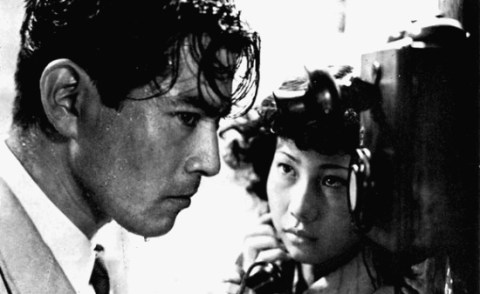
STILL: Kurosawa Akira
The changes that have taken place in the surrounding neighbourhood are vastly significant of the progress of a beef-eating people
September 19, 2013 § Leave a comment
If there is a particular practice that epitomises the sanctuaries, it is the rescue. This was the forcible release of a prisoner from the custody of an authority, be it the law, the military or bailiffs. Whilst it was common enough during the eighteenth century – especially when the press gang was on the prowl – the sanctuaries provided two enhancements: a ready crew for mounting them and a place of safety from recapture.
The following document from 1697 shows a rescue more or less carried out ‘to order.’ Two men were being taken under habeas corpus from Somerset to the London courts; a letter requesting their rescue was sent to one Thomas Gurney in Whitefriars, who raised a troop and intercepted them. read more
FILM: ARD
Grand grincome on your sentences!
September 18, 2013 § Leave a comment

I don’t even think Holder takes Holder seriously anymore; this is about the fifth time he’s said something like this. They’ve been busy propagating the myth that this is the first virgin crisis, conceived without sin…
We’ve got a million people that work in the criminal-justice system and 2300 of them do elite white-collar crime… they only come when there’s a criminal referral and banks don’t make criminal referrals against their own CEOs, which is why, in the Savings and Loan débacle we, the Office of Thrift Supervision, made over 30,000 criminals referrals… Flash forward to this crisis over 70 times larger in terms of losses and fraud and the same agency, the Office of Thrift Supervision, made zero criminal referrals; the Office of the Comptroller of the Currency made zero criminal referrals; the Fed appears to have made zero criminal referrals; the FDIC was smart enough to refuse to answer to the question…
Risk has virtually nothing to do with vast aspects of this crisis, at least risk as we conventionally talk about it in finance. If you follow the accounting control fraud recipe you are mathematically guaranteed in the near term to report record profits… watch
ART: Tilman Hornig
William Shakspar’s ‘Living, or not living’ soliloquy · PBS’s Ozymandias · John Milton’s On His Glaucoma · Thomas Hood’s No · Arthur Gordon Pym’s Black Bird · Arthur Rimbaud’s Vocalisations
September 17, 2013 § Leave a comment

A 71-year-old man in Gifu Prefecture made headlines recently when he attempted to initiate a lawsuit against broadcaster NHK. Through its excessive use of foreign derived words, the man claimed, NHK had caused him 精神的苦痛 (seishinteki kutsū, psychological pain). He demanded ¥1.41 million in 慰謝料 (isharyō, damages).
The local court refused to hear the case. But Nikkan Gendai newspaper (July 5) rose to the man’s defense, saying その気持ち、よく分かる (sono kimochi, yoku wakaru, that feeling is well understood), adding 政治もビジネスも、今やカタカナ語だらけ (seiji mo bijinesu mo ima ya katakana-go darake, now more than ever, politics and business are full of katakana loanwords).
だらけ(darake) is a useful descriptive suffix implying, negatively, that something is full of, or crawling with, whatever.
The term カタカナ語 (katakana-go) is used alternatively with 外来語 (gairaigo, words that come from outside, i.e., of foreign origin), but differentiates such words specifically as being written using the katakana syllabary, as opposed to borrowings from Chinese written in kanji.
Nikkan Gendai’s writer recalls that Prime Minister Shinzo Abe, in his first-term inaugural speech back in 2006, had used such awkward expressions as イノベーションの創造 (inobēshon no sōzō, creation of innovation) and テレワーク人口の倍増 (terewāku jinkō no baizō, doubling the number of teleworkers, i.e., telecommuters). These terms, said the writer, resulted in 多くの国民がチンプンカンプンだった (ōku no kokumin ga chinpun-kanpun datta, came across as gibberish to many citizens). チンプンカンプン (chinpun-kanpun, gibberish) is of indeterminate origin, although its close resemblance to the Mandarin Chinese phrase 聽不懂,看不懂 ting bu dong, kan bu dong, (literally “hear-not-understand, see-not-understand”) has not escaped notice. read more
ART: Maija Luutonen
Allegory, mother of all dogmas
September 16, 2013 § Leave a comment

Wedding photo, no date. On the back is written “G. Place.”
Found in “The Story of America in Pictures” arranged by Alan C. Collins. Published by The Literary Guild, 1935. look
PHOTOGRAPH: Tanuma Takeyoshi
Meseems he softly coileth magic meshes
September 13, 2013 § Leave a comment

If anyone is interested, I’m renting out my bedroom in Williamsburg, Brooklyn immediately. I apologize for the short notice. The apartment features a kitchenette, a large (by New York standards, ha ha) bathroom, and a roommate that’s going to have some opinions on Syria.
I’d like to return to my apartment, but I know that as soon as I do, I’ll be confronted by a roommate with opinions on the Syrian conflict and a determination to share them with me. The apartment has high ceilings and exposed brick along the far wall. At only $800/month it’s a steal for the location.
I won’t listen to your god damn opinions on Syria, Mike. I won’t do it.
Situated between the L, JMZ, and G trains, it’s convenient no matter where you work and the neighborhood is loaded with great restaurants and bars. It never ends with Syria. It just keeps going until he’s shared every opinion he has and then he just circles back and repeats. Utilities included.
As for me, I haven’t been home in a week. I’ve been staying late at work, and then grounding myself at a bar until last call. Then I wander the streets until dawn breaks. Cold, afraid, and lonely; content only in knowing that I don’t have to talk to my roommate about Syria.
Oh really, Mike? “Apathy towards the Middle East is bankrupting this nation’s morality”? Stop using my shampoo.
The room is available immediately as I will never return. read more
COLOURING: mkinde
Chapter 2 verses 8-11. “On the second day the Lord Southeastern did make one train early. And the people were red of face and short of breath but on time. And the second train did He make late – as he had yesternight – and the people did wonder at the repetition of his will”. Here endeth the lesson
September 12, 2013 § Leave a comment

Oregon Trail was played for the first time in Rawitsch’s history class on December 3, 1971. He wheeled the school’s machine into the classroom and turned it on as the class watched curiously. He divided them into teams and handed out paper maps to follow along.
There were a few obvious problems right away. With only one teletype, each group had to wait up to half an hour for its turn.
It didn’t take long for the kids to poke holes in the hastily assembled code. They could enter negative amounts of money and actually add to their coffers. Sometimes they were told the date was October 0, 1848.
Eventually other teachers would protest that the mention of “Indians” wasn’t politically correct.
But on the first day, none of that mattered to Rawitsch.
“They loved it,” he remembers. “The person who was good at the map kept track of where they were, the person who was good at math kept track of the money. They formed a little collaborative.”
Depending on the students’ choices, each game came out a little differently. And though few made it to the end alive, rather than quit, the kids wanted to try again.
The trio of student teachers loaded the program onto the schools’ so-called “timesharing” system, a library of programs that were accessible from teletypes within the Minneapolis school district. Dillenberger started letting his math students at Bryant try it, and soon kids were lined up six or seven deep outside the janitor’s closet. They began arriving early to play and staying until teachers kicked them out.
“We knew there was something special about it,” says Dillenberger.
When the semester ended, however, Rawitsch went in and deleted the program. Oregon Trail went dark. He printed out the code—hundreds and hundreds of lines of it on a long roll of yellow computer paper—rolled it up, and took it home.
It would be years before any student traveled the Oregon Trail again.
“I really didn’t have an idea of how something more could be done with it.” read more
PHOTOGRAPH: Renee Ruin
I achieved what all artists dread: I had outlived most of my money and all of my talent
September 11, 2013 § Leave a comment

In Japan in the early 1990s, a young psychiatrist named Saitō Tamaki began seeing patients with a cluster of strange symptoms. Actually, he barely saw them at all; more often than not, other family members would approach him about a brother or a son who was afflicted with an unfamiliar state. Mostly men on the threshold of adulthood, they were retreating to their rooms, shrinking from all social contact or communication, and closing off into themselves, often for periods of a year or more. Not wanting to kill themselves but unable to live in society, these youths folded inward in an attempt to fit themselves away. Saitō began calling them hikikomori sainen, “withdrawn young men,” and in 1998 published a book with his findings called Shakaiteki hikikomori—Owaranai Shishunki, or Social Withdrawal—Adolescence Without End.
Saitō ventured a count: There were 1 million people in a state of withdrawal or hikikomori, about one percent of the Japanese population. Eighty percent of them were men; 90 percent were over 18. “Social withdrawal is not some sort of ‘fad’ that will just fade away,” Saitō wrote. It is “a symptom, not the name of an illness,” and “there has been no sign that the number of cases will decrease.” His book became a best seller in weeks. Hikikomori joined otaku (a person with obsessive interests) and karoshi (death from overwork) as a loan word in English to describe a new social phenomenon that at first appeared uniquely Japanese. A few American authors have picked up on it as an enigmatic or convenient trope (in books like Shutting Out the Sun: How Japan Created Its Own Lost Generation by Michael Zielenziger and Hikikomori and the Rental Sister by Jeff Backhaus, most recently). But only now has Saitō’s original work been translated, by Jeffrey Angles, published by University of Minnesota Press in March.
Culturally bound psychological phenomena always fascinate the press because they excite the categories of racism through a veneer of scientificity. But Saitō was explicit on this point: Though his patients’ symptoms all emerged in some way through the Japanese social order, there was nothing intrinsically Japanese about the phenomenon. In fact, he had coined the term hikikomori to translate work that an American psychologist had done on similar cases of acute social withdrawal and later joined it up with the sociological category of NEETs (not in education, employment, or training) in Britain. His internationalism slyly made room for an astonishing claim: The structure of age itself was beginning to break down. read more
PHOTOGRAPH: Clifford R Adams
We work really hard on our setlist and our act. It’s not a horrible mistake that I’m not singing any songs. I’m the bass player. It’s like everybody has all of a sudden turned into my mother
September 10, 2013 § Leave a comment

When looking at medieval manuscripts, some easily gravitate to the ornamented and heavily illuminated pages for their spectacular visual quality. There is no question that the most well-known and widely reproduced images from the most famous manuscripts are usually the “pretty” pages. Serious scholarship provides important refinements to our understanding of these visual elements. Others capably focus on the text–sometimes a unique exemplar–that is inscribed on the pages. Where possible, they study the variations between different copies, comparing word for word. Still others are drawn to examine features of the codex or the paleography in all the minute details of composition and structure. These view the manuscript as an artifact capable of revealing much of its own history along with connections to other manuscripts or associated cultural phenomena.
In the course of my own explorations of medieval manuscripts (both hands-on and digitally), I have struggled to find an approach that allows for an overall appreciation of the entire object–to get a sense somehow for the whole thing. Already, the experience of hefting one of these historic volumes offers unique if vague satisfaction to the senses, even before opening it. One becomes aware of the weight, the dimensions, the wear and discoloration of the cover, the smell, and even the sounds it makes when the clasps are opened. The binding groans while the parchment crackles in response to the most careful gestures to leaf through it.
The Manuscript Average
Today, images of many thousands of manuscripts are available through digital repositories to casual and serious viewers. Without the physical presence of the actual volume between our hands, is there a way for us to take in some aspect of it all at once? For instance, what if we took all the pages of a given manuscript and overlaid them as if they were transparent? read more
PHOTOGRAPH: Yijun Liao
I have no interest in banking or bookkeeping. My interest is monetary policy
September 9, 2013 § Leave a comment

This article gives an account of a 2-year project to establish the fate of the mental hospitals in three areas of the UK. There were two aims: to determine the proportion of mental hospitals that are currently open and to provide descriptive data on the fate of those that had closed….
Study of the advertising brochures supplied by property developers was possible for 12 of the former hospital buildings that were undergoing conversion. The other 14 converted hospital buildings had already been sold and were not on the market, so no material was available to study. Examples of the language employed by property developers in sales brochures advertising old hospital buildings included ‘sanctuary’ and ‘seclusion’ in ‘grade II listed buildings’, ‘tastefully converted period buildings’ and ‘luxury penthouses’. There was a strong emphasis on security, with ‘a secure and private environment’, ‘24 hour security guards’, ‘security gates’ and ‘CCTV surveillance’. Original asylum architecture is even imitated in modern buildings: ‘the classic facades that emulate the original architecture’, and the clock tower of one former hospital was used as a symbol to represent the whole development.
Residents at the redeveloped site of Nethern Hospital will be greeted by ‘the gentle bounce of tennis balls on private courts’ and ‘the distant voices of children’. They will, however, remain unaware of the 1976 inquiry into high levels of suicides that found serious understaffing and unsatisfactory conditions on the wards. At St George’s Park in Oxfordshire, prospective buyers were informed of the ‘original 19th century elegance’ and ‘original features including high ceilings’. They are not informed that the original psychiatric hospital has been newly built over the road. In total, reference was made to the former psychiatric hospitals in only four of the 12 promotional brochures and web sites. This was in the general reference to a former hospital or by euphemistic language, such as ‘society’s less able’, referring to people with learning disability at Earlswood Hospital. read more
ART: Derek Paul Boyle
 my nerves are bad to-night