Dirk Bogarde shopping alone. A dropped glove. The only person not laughing in an audience
July 12, 2013 § Leave a comment

For 50 days, Zannier recorded every website he visited, every chat conversation he had, every mouse movement. He even tracked where he walked and took a picture of himself using his computer every 30 seconds. He’s selling that trove of personal information for $2 a day or $250 for the whole lot.
“In the market, people are making money with my personal data, and as a provocation, I said, ‘OK, I want to try to make money with my own data.’ ”
He’s not expecting any marketers to pay up. This is a thesis project for his New York University grad program. Although, more than 115 people have already bought some of his data .
So, is $2 a good deal? Zannier isn’t sure.
“I don’t know. It just was a random number.”
But Jaron Lanier, the author of Who Owns the Future? says he thinks Zannier is undercharging. read more
PHOTOGRAPH: Alexandra Auger
And if that didn’t happen, well, there was always an explanation, which was an inadequate degree of zeal
July 11, 2013 § Leave a comment
In 1837, the British cutter Lambton sailed from Sydney to Ngatik (now Sapwuahfik), a tiny island in Micronesia. On orders from Captain Charles “Bloody” Hart, who hoped to take control of the valuable supply of tortoise shells there, the crew massacred all the men on the island. They left behind some European and Ponapean crew members, installing an Irishman named Paddy Gorman as a “chief,” and the sailors claimed the widowed island women as their wives.
Today, the islanders speak a dialect of the Ponapean language of the region. But there is another language spoken on the island, called Ngatikese Men’s Language or Ngatikese Pidgin, that is spoken only by men. It was described by the late well-known linguist of Austronesian languages, Darrell Tryon. The women and children on the island can understand it, but it is primarily used among men engaged in male domain activities like fishing and boat-building. It developed from an English-based pidgin—one of many in Austronesia—but because Ngatik lies so far from the main shipping routes of the region, it resisted further mixing, remaining today a sort of preserved historical crumb dropped from a passing ship. It is the echo of the voices of those 19th century sailors.
This makes it different from the other pidgins of the region, such as Tok Pisin and Bisalma, which developed over a long period of steady contact with shipboard language, and have many features in common with each other. read more
ART: Jessica Harrison
It would be easier to die for me than to live for me
July 10, 2013 § 1 Comment

Saturday, July 27, 2013
1:00 PM to 8:00 PM
Needs a location
Price: $450.00/per person
WHEN YOU RSVP FOR THIS WORKSHOP. YOU GET TWO MORE WORKSHOPS AS YOUR BONUS!
(1) BONUS 1 DECODING HOW TO KEEP THE CONVERSATION GOING (CONVERSING LEVEL)
(2) THE INVINCIBLE MAN: BEYOND THE CONFIDENCE TRAP (SELF-COMMAND LEVEL)
Many men mistakenly believe that women are psychologically and physical sexually turned on like men. Sexual arousal in women first starts inside her brain. Women have two different brains that you must effect to successfully create sexual relationships.The first is her social brain and the second is her erotic emotional brain. “Subliminal Erotic Conversation” is a system of non-conscious tools that allows any man to turn-on sexual desire in women. “Subliminal Erotic Conversation” is the art and science of using deep persuasive language to get women to assemble sensations, emotions, and thoughts.
Using S.E.C makes it possible to turn-on both the sexual fantasies and bodies of women. Experiences so powerful women are compelled to act with lustful abandon.
She may jump on top of you-REALLY!
This workshop is about real tools and science of seduction.
Learn the specific codes to sexually turn on 90% of women worldwide. read more
PHOTOGRAPH: Kenda North
he likes to be on the right side of history (a shame, really, as his New Labour project was closer to Khrushchev ameliorating the worst excesses of a system beginning its terminal phase than it was to establishing a new one)
July 9, 2013 § Leave a comment

But let’s not mistake sex for the main event. The endless manual jimmying and ripped foil packets and escalating rhythms and release-findings are just foreplay for the real climax, in which Anastasia recognizes that she’s destined to abandon her ordinary, middle-class life in favor of the rarefied veal pen of the modern power elite. Until then, like a swooning female contestant on The Bachelor, Anastasia is offered breathtaking helicopter and glider rides, heady spins in luxury sports cars, and windswept passages on swift catamarans. She is made to gasp at Christian’s plush office, with its sandstone desk and white leather chairs and its stunning vista, or his spacious, immaculate penthouse apartment, with its endless rooms filled with pricey furniture. She is treated to Bollinger pink champagne and grilled sea bass. She is offered a brand new wardrobe replete with stylish heels and gorgeous gowns and designer bras. She is lavished with diamond jewelry and flowers and a new luxury car of her own.
Soon the numbing parade of luxe brands—Cartier, Cristal, Omega, iPad, iPod, Audi, Gucci—takes on the same dulled impact as endlessly tweaked nipples and repeatedly bound wrists. Curiously (but perhaps not surprisingly), our heroine’s responses to these artifacts of her ascendance are eerily similar to her sexual responses: “Oh, my!” “Yes.” “Holy shit!” After that, the superior quality and enormous cost of each item are mulled in excruciating detail. Just as traditional, male-centered pornography seems to feature a particularly clumsy, childish notion of sexiness, the concept of luxury on offer in Fifty Shades is remarkably callow. Like an update of the ostentatious, faux-tasteful wealth of Dynasty, Christian’s penthouse, with its abstract art and dark wood and leather, represents the modern version of enormous flower arrangements and white marble and a house staff trussed up in cartoon-butler regalia. No detail of the environment feels organic or specific to Christian himself; instead, it reflects a prescribed corporate aesthetic of enormous wealth that for some reason James approaches with reverence rather than repulsion or dread. By the time this compulsive lifestyle voyeurism starts invading our narrator’s routine visits to the bathroom (“The restrooms are the height of modern design—all dark wood, black granite, and pools of light from strategically placed halogens”), the author’s veneration of arbitrary signifiers of class has begun to take on grotesque, faintly comedic proportions. read more
ART: Edoardo de Falchi
“But Ingolf’s copy wasn’t the original,” I said. “The parchment was the original.” “Casaubon, when originals no longer exist, the last copy is the original.”
July 8, 2013 § Leave a comment
While “cyber” has been around for a few decades as a prefix and an adjective relating to computer networks, it has taken on a new life as a stand-alone noun, especially among military and intelligence types who use it as shorthand for “cybersecurity.”
As a prefix, “cyber-” originated in “Cybernetics,” the title of a 1948 book by Norbert Wiener, subtitled “Control and Communication in the Animal and the Machine.” Mr. Wiener based his neologism on the Greek word kybernētēs, meaning “steersman” or “guide” (also the root of the word “governor”). By the 1960s, as computing matured, “cyber-” began branching out as a prefix in words like “cyberculture” and “cybernaut.”
Then in the early 1980s, science-fiction writers exploring virtual worlds got in on the act. William Gibson introduced “cyberspace” in his 1982 short story “Burning Chrome” and then brought it to a wide audience a couple of years later in his novel “Neuromancer.” Meanwhile, in 1983, Bruce Bethke titled a story “Cyberpunk,” and by 1986 that word had come to name a sci-fi genre, pioneered by Mr. Gibson, with high-tech narratives set in a bleakly dystopian future, often featuring “cyborgs” (short for “cybernetic organisms”).
In the ’90s, that bleakness was replaced by the burgeoning Internet culture’s optimism, as “cyberspace” was reimagined as welcoming. Cyber-coinages abounded, as with spending “cybercash” at a “cybermall.”
Most “cyber” words fell by the wayside, in part shoved aside by the snappier “e-” (for “electronic”), as in “e-commerce.” So when retailers in 2005 began hyping “Cyber Monday” (the Monday after Thanksgiving) as a big day for online shopping, “cyber” already seemed quaint.
But “Cyber Monday” caught on, and some other cyber-words have proved sturdy, like “cyberbullying” and “cyberstalking.” It is in the security sector, however, that “cyber” has made its biggest inroads. read more
I that have poured out mine eyes upon books, & well-nigh spit out my brain at my tongue’s end this morning, am dumpish, drowsy & wish myself dead
July 5, 2013 § Leave a comment
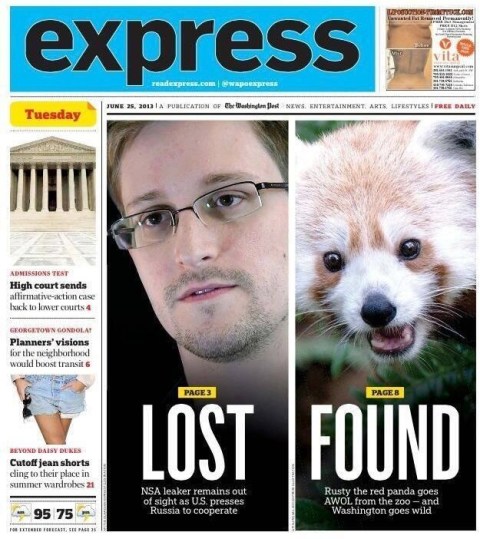
Under copyright law, a music recording has two automatically assigned property rights: A musical composition has a property right and a recording has a separate and independent property right. These property rights are limited by term. In the UK, the term of copyright in a literary, dramatic, musical or artistic work is limited to the life of the author plus 70 years, while the term of copyright in a sound recording is limited to 50 years from the date of recording. The archive attempts to gather recordings and information about recordings whose proprietary interests have expired and make them accessible to a wider public. read more
COVER: Washington Post Express
Who cares if they’re rolling in bed? There’s only darkness upstairs
July 4, 2013 § Leave a comment

That’s one of the most extraordinary bird songs in the British Isles…
At first there was nothing and then a low and gentle noise came very softly from the Bowl, a faint sound, almost indescribable, but as if one held the tongue against the roof of the mouth and expelled the breath. listen
ART: Nina Tichava
I saw the best minds of my generation / Accept jobs on the fringes of the entertainment industry
July 3, 2013 § Leave a comment

Count Drago’s uncanny simulacra remind us of the kinship between taxidermy and photography, which arrests the flight of time, fixing the moment forever. The movie’s bargain-basement special effects literalize this metaphoric connection: when a cat laps up some brandy spiked with the count’s elixir of death, it freeze-frames blurrily, a time fossil trapped in the amber of a filmed instant. Oliver Wendell Holmes took note of this connection in the art’s infancy: in his 1859 essay, “The Stereoscope and the Stereograph,” Holmes announces the coming of the Matrix reality we now inhabit, where reproductions and originals are increasingly indistinguishable.
Form is henceforth divorced from matter. In fact, matter as a visible object is of no great use any longer, except as the mold on which form is shaped. Give us a few negatives of a thing worth seeing, taken from different points of view, and that is all we want of it. … Matter in large masses must always be fixed and dear; form is cheap and transportable. We have got the fruit of creation now, and need not trouble ourselves with the core. … Men will hunt all curious, beautiful, grand objects, as they hunt the cattle in South America, for their skins, and leave the carcasses as of little worth.
The count’s problem is that it’s sometime around 1815, photography hasn’t been invented yet, and he’s trying to create the “instant suspension of life” that photography will soon make possible—taxidermy with the snap of a shutter, skinning the image to preserve it for eternity. read more
PHOTOGRAPH: Kaitlin Rebesco
Guardian reports that Ireland has fallen back into recession “despite” its multi-billion euro austerity drive
July 2, 2013 § Leave a comment

When I returned home from my recent road trip, a letter from Blue Cross Blue Shield of Illinois (my health insurance company, also known as BCBSIL) was waiting for me. Even though I already knew they denied my appeal for last September’s biopsy, I was amazed at how quickly I transitioned from tired but happy traveler to enraged cancer patient.
The upshot of their message was this:
“You already have metastatic lung cancer. A biopsy won’t change the fact that you’re going to die from cancer.”
The statement probably came from the independent “physician who specializes in Internal Medicine/Pulmonary Disease” who reviewed my appeal. You can judge for yourself whether I’m overreacting from this excerpt. I bolded some words for emphasis.
” … in this case the member is already known to have progressive Stage IV Bronchogenic carcinoma even after therapy. Specifically identifying the histopathology of this right upper lobe lesion is not going to affect long-term health outcomes.”…
When BCBSIL denied the claim, I appealed. I explained my treatment history, including that my cancer is aggressive, and we needed to know if the nodule were BOOP or cancer to give me appropriate treatment. My doctor reviewed my letter and wrote a letter of his own to stick in the packet. I included scan CDs and appropriate medical reports.
Evidently that wasn’t enough. Because, well, I’m gonna die anyway…
What frosts me about this letter is that a “specialist” decided there was no urgency to get a biopsy because it wouldn’t change my “long-term health outcome.” Did he expect me to go on steroids AND chemo (both of which have a significant impact on quality of life) in case one of them MIGHT work? Or do nothing, since I’m going to die anyway? Well, here’s a news flash: we’re ALL going to die! The purpose of medicine is to keep us as healthy as possible while delaying that inevitable long-term outcome as long as possible. read more
ART: Andreas Bahn
Understand death? Sure. That was when the monsters got you
July 1, 2013 § Leave a comment

An extraordinary fuss about eavesdropping started in the spring of 1844, when Giuseppe Mazzini, an Italian exile in London, became convinced that the British government was opening his mail. Mazzini, a revolutionary who’d been thrown in jail in Genoa, imprisoned in Savona, sentenced to death in absentia, and arrested in Paris, was plotting the unification of the kingdoms of Italy and the founding of an Italian republic. He suspected that, in London, he’d been the victim of what he called “post-office espionage”: he believed that the Home Secretary, Sir James Graham, had ordered his mail to be opened, at the request of the Austrian Ambassador, who, like many people, feared what Mazzini hoped—that an insurrection in Italy would spark a series of revolutions across Europe. Mazzini knew how to find out: he put poppy seeds, strands of hair, and grains of sand into envelopes, sealed the envelopes with wax, and sent them, by post, to himself. When the letters arrived—still sealed—they contained no poppy seeds, no hair, and no grains of sand. Mazzini then had his friend Thomas Duncombe, a Member of Parliament, submit a petition to the House of Commons. Duncombe wanted to know if Graham really had ordered the opening of Mazzini’s mail. Was the British government in the business of prying into people’s private correspondence? Graham said the answer to that question was a secret.
Questions raised this month about surveillance conducted by the National Security Agency have been met, so far, with much the same response that Duncombe got from Graham in 1844: the program is classified. (This, a secret secret, is known as a double secret.) Luckily, old secrets aren’t secret; old secrets are history. The Mazzini affair, as the historian David Vincent argued in “The Culture of Secrecy,” led to “the first modern attack on official secrecy.” It stirred a public uproar, and eventually the House of Commons appointed a Committee of Secrecy “to inquire into the State of the Law in respect of the Detaining and Opening of Letters at the General Post-office, and into the Mode under which the Authority given for such Detaining and Opening has been exercised.” In August of 1844, the committee issued a hundred-and-sixteen-page report on the goings on at the post office. Fascinating to historians, it must have bored Parliament silly. It includes a history of the delivery of the mail, back to the sixteenth century. (The committee members had “showed so much antiquarian research,” Lord John Russell remarked, that he was surprised they hadn’t gone all the way back to “the case of Hamlet, Prince of Denmark, who opened the letters which had been committed to his charge, and got Rosencrantz and Guildenstern put to death instead of himself.”)
The report revealed that Mazzini’s mail had indeed been opened and that there existed something called the Secret Department of the Post Office. Warrants had been issued for reading the mail of the king’s subjects for centuries. Before Mazzini and the poppy seeds, the practice was scarcely questioned. It was not, however, widespread. “The general average of Warrants issued during the present century, does not much exceed 8 a-year,” the investigation revealed. “This number would comprehend, on an average, the Letters of about 16 persons annually.” The Committee of Secrecy was relieved to report that rumors that the Secret Department of the Post Office had, at times, sent “entire mail-bags” to the Home Office were false: “None but separate Letters or Packets are ever sent.”
The entire episode was closely watched in the United States, where the New-York Tribune condemned the opening of Mazzini’s mail as “a barbarian breach of honor and decency.” After the Committee of Secrecy issued its report, Mazzini published an essay called “Letter-Opening at the Post-Office.” Two months after the Mazzini affair began, the Secret Department of the Post Office was abolished. What replaced it, in the long run, was even sneakier: better-kept secrets. read more
PHOTOGRAPH: Derek Vincent
 my nerves are bad to-night