Merdre!
July 16, 2013 § Leave a comment
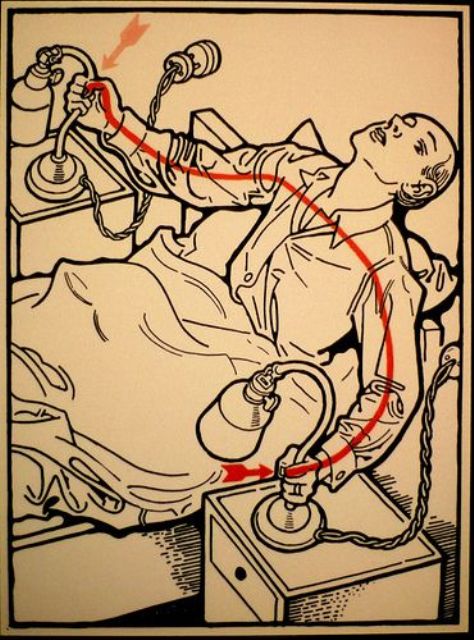
We often hear that our ecological crisis is the result of our short-term egotism: obsessed with immediate pleasures and wealth, we forgot about the common good. However, it is here that Walter Benjamin’s notion of capitalism as religion becomes crucial: a true capitalist is not a hedonist egotist; he is, on the contrary, fanatically devoted to his task of multiplying his wealth, ready to neglect his health and happiness, not to mention the prosperity of his family and the well-being of environment, for it. There is thus no need to evoke some high-ground moralism and trash capitalist egotism. To put it in the terms of Alain Badiou: the subjectivity of capitalism is not that of the “human animal” but rather a call to subordinate egotism to the self-reproduction of the capital.
In other words, self-interested egotism is not the brutal fact of our societies but its ideology – the ideology articulated in Hegel’s The Phenomenology of Spirit under the name of “the spiritual kingdom of animals” – his phrase for the modern civil society in which human animals are caught in self-interested interaction. read more
ART: Stefan Jellinek
a helpful writing tip is to go back through your first draft and remove all the nouns
January 9, 2013 § Leave a comment

In September 1940 the German-Jewish intellectual Walter Benjamin walked into the French Pyrenees towards the Spanish border and never came back. It seems that when the Spaniards barred his passage, he swallowed morphine tablets to elude the Nazis. He received a Catholic funeral, as “Dr Benjamin Walter”, in the Spanish border town of Portbou.
Today the Franco-Spanish border, like most in Europe, barely exists. It’s just a half-forgotten line of stones on a field, photographed by Valerio Vincenzo in one of three magnificent photo-essays on borders showcased here. Nowadays you often only know you have crossed a European border when the telecoms provider on your cellphone changes. Yet as our pictures from Israel, Korea and the Mexico-US frontier show, elsewhere borders still very much exist. The militarised fence photographed by Gary Knight in Arizona’s Sonora desert looks as if it could stand for ever.
But it won’t. Closed borders are by their nature unstable. Too many forces – similarity on both sides of the fence, trade, desire for happiness – gnaw away at them. Already the southeast Asian states united in Asean are pursuing European-style porous borders by 2015. The South American countries in Mercosur have stumbled along a similar path. There’s reason to hope more regions will follow Europe’s example. In most places, history seems to be working against borders.
In the decades before the first world war, you could generally cross a European border without a passport. The movement of people and ideas helped make neighbouring countries more similar. From 1914, European borders began to tighten. The process reached its nadir in 1961, when Berliners woke one summer Sunday morning to find that the East German regime was building a wall through town. At least the wartime restrictions that killed Benjamin had been exceptional. With the Berlin Wall, closed borders became the everyday European reality.
There is a poignant piece of footage from that day: Berliners are standing around beside the rising fence, when suddenly a man and a small dog come running into the picture from the east. The man hurdles the waist-height wire and lands in west Berlin. But his dog, leaping after him, hits the wire. A border guard grabs the animal. The man and bystanders implore him to give it back. He refuses. read more
PHOTOGRAPH: Laura Kok
 my nerves are bad to-night